Showing posts with label IRS. Show all posts

Thursday, January 19, 2017

IRS Tests W-2 Verification Code for Filing Season 2017

For filing season 2017, the Internal Revenue Service will expand an initiative to verify the authenticity of Form W-2 data. This initiative is one in a series of steps to combat tax-related identity theft and refund fraud.

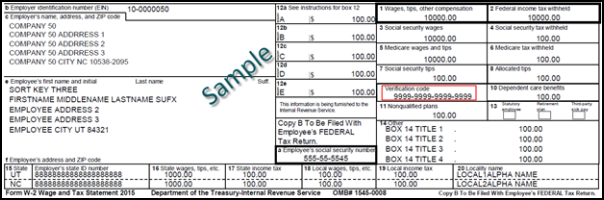
The objective is to verify Form W-2 data submitted by taxpayers on e-filed individual tax returns. The IRS has partnered with certain Payroll Service Providers (PSPs) to include a 16-digit code and a new Verification Code field on a limited number of Form W-2 copies provided to employees.
Verification codes will appear on approximately 50 million Forms W-2 in 2017, up from the 2 million forms in 2016. Tax professionals are urged to look for “Verification Code” on W-2s because location will vary.

The code will be displayed in four groups of four alphanumeric characters, separated by hyphens. Example: XXXX-XXXX-XXXX-XXXX.

The Verification Code will appear on some versions of payroll firms’ Form W-2 copies B and C, in a separate, labeled box (Copy B is "To be filed with employee's federal tax return" and Copy C is "For employee's records.")

The form will include these instructions to taxpayer and tax preparers:

Verification Code. If this field is populated, enter this code when it is requested by your tax return preparation software. It is possible your software or preparer will not request the code. The code is not entered on paper-filed returns.

Some Forms W-2 employees receive will have a “Verification Code” box which is blank. These taxpayers do not need to enter any code data into their tax software product.
For the purposes of the test, omitted and incorrect W-2 Verification Codes will not delay the processing of a tax return.

The code will not be included in Forms W-2 or W-2 data submitted by the PSPs to the Social Security Administration or any state or local departments of revenue. Nor will this pilot affect state and local income tax returns or paper federal returns.

Friday, March 18, 2016

IRS Removes Some Restrictions on Cuba Income

Thursday, January 14, 2016

Get to Know Your Taxpayer Bill of Rights

Every taxpayer has a set of fundamental rights. The “Taxpayer Bill of Rights” takes the many existing rights in the tax code and groups them into 10 categories. You should be aware of these rights when you interact with the IRS.

Publication 1, Your Rights as a Taxpayer, highlights a list of your rights and the agency’s obligations to protect them. Here is a summary of the Taxpayer Bill of Rights:

  1. The Right to Be Informed. Taxpayers have the right to know what is required to comply with the tax laws. They are entitled to clear explanations of the laws and IRS procedures in all tax forms, instructions, publications, notices and correspondence. They have the right to know about IRS decisions affecting their accounts and clear explanations of the outcomes.
  2. The Right to Quality Service. Taxpayers have the right to receive prompt, courteous and professional assistance in their dealings with the IRS and the freedom to speak to a supervisor about inadequate service. Communications from the IRS should be clear and easy to understand.
  3. The Right to Pay No More than the Correct Amount of Tax. Taxpayers have the right to pay only the amount of tax legally due, including interest and penalties. They should also expect the IRS to apply all tax payments properly.
  4. The Right to Challenge the IRS’s Position and Be Heard. Taxpayers have the right to object to formal IRS actions or proposed actions and provide justification with additional documentation. They should expect that the IRS will consider their timely objections and documentation promptly and fairly. If the IRS does not agree with their position, they should expect a response.
  5. The Right to Appeal an IRS Decision in an Independent Forum. Taxpayers are entitled to a fair and impartial administrative appeal of most IRS decisions, including certain penalties. Taxpayers have the right to receive a written response regarding a decision from the Office of Appeals. Taxpayers generally have the right to take their cases to court.
  6. The Right to Finality. Taxpayers have the right to know the maximum amount of time they have to challenge an IRS position and the maximum amount of time the IRS has to audit a particular tax year or collect a tax debt. Taxpayers have the right to know when the IRS concludes an audit.
  7. The Right to Privacy. Taxpayers have the right to expect that any IRS inquiry, examination or enforcement action will comply with the law and be as unobtrusive as possible. They should expect such proceedings to respect all due process rights, including search and seizure protections. The IRS will provide, where applicable, a collection due process hearing.
  8. The Right to Confidentiality. Taxpayers have the right to expect that their tax information will remain confidential. The IRS will not disclose information unless authorized by the taxpayer or by law. Taxpayers should expect the IRS to take appropriate action against employees, return preparers and others who wrongfully use or disclose their return information.
  9. The Right to Retain Representation. Taxpayers have the right to retain an authorized representative of their choice to represent them in their dealings with the IRS. Taxpayers have the right to seek assistance from a Low Income Taxpayer Clinic if they cannot afford representation.
  10. The Right to a Fair and Just Tax System. Taxpayers have the right to expect fairness from the tax system. This includes considering all facts and circumstances that might affect their underlying liabilities, ability to pay or ability to provide information timely. Taxpayers have the right to receive assistance from the Taxpayer Advocate Service if they are experiencing financial difficulty or if the IRS has not resolved their tax issues properly and timely through its normal channels.

In an effort to expand awareness, the IRS has made Publication 1 available in  EnglishChineseKoreanRussianSpanish andVietnamese.

The IRS will include Publication 1 when sending a notice to taxpayers on a range of issues, such as an audit or collection matter. All IRS facilities will publicly display the rights for taxpayers and employees to see.

Additional IRS Resources:

IRS YouTube Videos:

IRS Podcasts:

Tuesday, November 24, 2015

IRS Tax Tips for Deducting Gifts to Charity


IRS.gov Banner
IRS Tax TipsNovember 24, 2015


Useful Links:

IRS.gov
Help For Hurricane Victims

News Essentials

What's Hot
News Releases
IRS - The Basics
IRS Guidance
Media Contacts
Facts & Figures
Around The Nation
e-News Subscriptions

The Newsroom Topics

Multimedia Center
Noticias en Español
Radio PSAs
Tax Scams/Consumer Alerts
The Tax Gap
Fact Sheets
IRS Tax Tips
Armed Forces
Latest News

IRS Resources

Compliance & Enforcement News
Contact Your Local IRS Office
Filing Your Taxes
Forms & Pubs
Frequently Asked Questions
Taxpayer Advocate Service
Where to File
IRS Social Media


Issue Number:    IRS Special Edition Tax Tip 2015-20

Inside This Issue


IRS Tax Tips for Deducting Gifts to Charity
The holiday season often prompts people to give money or property to charity. If you plan to give and want to claim a tax deduction, there are a few tips you should know before you give. For instance, you must itemize your deductions. Here are six more tips that you should keep in mind:
1. Give to qualified charities. You can only deduct gifts you give to a qualified charity. Use the IRS Select Check tool to see if the group you give to is qualified. You can deduct gifts to churches, synagogues, temples, mosques and government agencies. This is true even if Select Check does not list them in its database.
2. Keep a record of all cash gifts.  Gifts of money include those made in cash or by check, electronic funds transfer, credit card and payroll deduction. You must have a bank record or a written statement from the charity to deduct any gift of money on your tax return. This is true regardless of the amount of the gift. The statement must show the name of the charity and the date and amount of the contribution. Bank records include canceled checks, or bank, credit union and credit card statements. If you give by payroll deductions, you should retain a pay stub, a Form W-2 wage statement or other document from your employer. It must show the total amount withheld for charity, along with the pledge card showing the name of the charity.
3. Household goods must be in good condition.  Household items include furniture, furnishings, electronics, appliances and linens. These items must be in at least good-used condition to claim on your taxes. A deduction claimed of over $500 does not have to meet this standard if you include a qualified appraisal of the item with your tax return.
4. Additional records required.  You must get an acknowledgment from a charity for each deductible donation (either money or property) of $250 or more. Additional rules apply to the statement for gifts of that amount. This statement is in addition to the records required for deducting cash gifts. However, one statement with all of the required information may meet both requirements.
5. Year-end gifts.  Deduct contributions in the year you make them. If you charge your gift to a credit card before the end of the year it will count for 2015. This is true even if you don’t pay the credit card bill until 2016. Also, a check will count for 2015 as long as you mail it in 2015.
6. Special rules.  Special rules apply if you give a car, boat or airplane to charity. If you claim a deduction of more than $500 for a noncash contribution, you will need to file another form with your tax return. UseForm 8283, Noncash Charitable Contributions to report these gifts. For more on these rules, visit IRS.gov.
Each and every taxpayer has a set of fundamental rights they should be aware of when dealing with the IRS. These are your Taxpayer Bill of Rights. Explore your rights and our obligations to protect them on IRS.gov.
Additional IRS Resources:
IRS YouTube Videos:
IRS Podcasts:

Thank you for subscribing to IRS Tax Tips, an IRS e-mail service. For more information on federal taxes please visit IRS.gov.
This message was distributed automatically from the IRS Tax Tips mailing list. Please Do Not Reply To This Message.

Wednesday, June 17, 2015

IRS, Industry, States Take New Steps Together to Fight Identity Theft, Protect Taxpayers

WASHINGTON — The Internal Revenue Service joined today with representatives of tax preparation and software firms, payroll and tax financial product processors and state tax administrators to announce a sweeping new collaborative effort to combat identity theft refund fraud and protect the nation's taxpayers.
The agreement — reached after the project was originally announced March 19 — includes identifying new steps to validate taxpayer and tax return information at the time of filing. The effort will increase information sharing between industry and governments. There will be standardized sharing of suspected identity fraud information and analytics from the tax industry to identify fraud schemes and locate indicators of fraud patterns. And there will be continued collaborative efforts going forward.
"This agreement represents a new era of cooperation and collaboration among the IRS, states and the electronic tax industry that will help combat identity theft and protect taxpayers against tax refund fraud," IRS Commissioner John Koskinen said. "We've made tremendous progress, and we will continue these efforts. Taxpayers filing their tax returns next filing season should have a safer and more secure experience."
Koskinen convened a Security Summit on March 19 with the chief executive officers and leaders of private sector firm and federal and state tax administrators to discuss emerging threats on identity theft and expand existing collaborative efforts to stop fraud.
Three specialized working groups were established as part of the Summit, with members from the IRS, states and industry co-chairing and serving on each team. During the past 12 weeks, the teams focused on developing ways to validate the authenticity of taxpayers and information included on tax return submissions, information sharing to improve detection and expand prevention of refund fraud, and threat assessment and strategy development to prevent risks and threats.
The groups agreed to several important new initiatives in this unprecedented effort, including:
Taxpayer authentication. The industry and government groups identified numerous new data elements that can be shared at the time of filing to help authenticate a taxpayer and detect identity theft refund fraud. The data will be submitted to the IRS and states with the tax return transmission for the 2016 filing season. Some of these issues include, but are not limited to:
    • Reviewing the transmission of the tax return, including the improper and or repetitive use of Internet Protocol numbers, the Internet ‘address’ from which the return is originating.
    • Reviewing computer device identification data tied to the return’s origin.
    • Reviewing the time it takes to complete a tax return, so computer mechanized fraud can be detected.
    • Capturing metadata in the computer transaction that will allow review for identity theft related fraud.  
Fraud identification. The groups agreed to expand sharing of fraud leads. For the first time, the entire tax industry and other parts of the tax industry will share aggregated analytical information about their filings with the IRS to help identify fraud. This post-return filing process has produced valuable fraud information because trends are easier to identify with aggregated data. Currently, the IRS obtains this analytical information from some groups. The expanded effort will ensure a level playing field so everyone approaches fraud from the same perspective, making it more difficult for the perpetration of fraud schemes.
Information assessment. In addition to continuing cooperative efforts, the groups will look at establishing a formalized Refund Fraud Information Sharing and Assessment Center (ISAC) to more aggressively and efficiently share information between the public and private sector to help stop the proliferation of fraud schemes and reduce the risk to taxpayers. This would help in many ways, including providing better data to law enforcement to improve the investigations and prosecution of identity thieves.
Cybersecurity framework. Participants with the tax industry agreed to align with the IRS and states under the National Institute of Standards and Technology (NIST) cybersecurity framework to promote the protection of information technology (IT) infrastructure. The IRS and states currently operate under this standard, as do many in the tax industry.
Taxpayer awareness and communication. The IRS, industry and states agreed that more can be done to inform taxpayers and raise awareness about the protection of sensitive personal, tax and financial data to help prevent refund fraud and identity theft. These efforts have already started, and will increase through the year and expand in conjunction with the 2016 filing season.
"Industry, states and the IRS all have a role to play in this effort," Koskinen said. "We share a common enemy in those stealing personal information and perpetrating refund fraud and we share a common goal of protecting taxpayers. We want to build these changes into the DNA of the entire tax system to make it safer."
Many major system and process changes will be made this summer and fall by the participants in order to be ready for the 2016 filing season. The public-private partnership also will continue this cooperative, collaborative approach to address not just short-term issues but longer-term issues facing the tax community and taxpayers.
The partnership parties recognize the need to continuously improve our tax system defenses for combating this threat to taxpayers and our tax system, Koskinen added. Those defenses include a continually improving multi-level identity proofing and authentication capability that anticipates and stops threats.
"I applaud the industry and the states for stepping forward to take on this challenge and making the needed changes," Koskinen. "This is good for taxpayers, good for tax administrators and good for the tax community."
Koskinen emphasized that a continuing theme throughout this effort focuses on protecting taxpayer information and privacy. “Working together we can achieve results that none of us, working alone, could accomplish,” he said.
In addition to companies from the private sector, the summit team included several groups including the Electronic Tax Administration Advisory Committee (ETAAC), the Federation of Tax Administrators (FTA) representing the states, the Council for Electronic Revenue Communication Advancement (CERCA) and the American Coalition for Taxpayer Rights (ACTR).
Page Last Reviewed or Updated: 11-Jun-2015

Tuesday, June 2, 2015

IRS Statement on the "Get Transcript" Application

The IRS announced today that criminals used taxpayer-specific data acquired from non-IRS sources to gain unauthorized access to information on approximately 100,000 tax accounts through IRS’ “Get Transcript” application. This data included Social Security information, date of birth and street address.
These third parties gained sufficient information from an outside source before trying to access the IRS site, which allowed them to clear a multi-step authentication process, including several personal verification questions that typically are only known by the taxpayer. The matter is under review by the Treasury Inspector General for Tax Administration as well as the IRS’ Criminal Investigation unit, and the “Get Transcript” application has been shut down temporarily. The IRS will provide free credit monitoring services for the approximately 100,000 taxpayers whose accounts were accessed. In total, the IRS has identified 200,000 total attempts to access data and will be notifying all of these taxpayers about the incident.

Thursday, March 19, 2015

Taxpayers Receiving Identity Verification Letter Should Use IDVerify.irs.gov

WASHINGTON – The Internal Revenue Service today reminded taxpayers who receive requests from the IRS to verify their identities that the Identity Verification Service website, idverify.irs.gov, offers the fastest, easiest way to complete the task.

Taxpayers may receive a letter when the IRS stops suspicious tax returns that have indications of being identity theft but contains a real taxpayer’s name and/or Social Security number. Only those taxpayers receiving Letter 5071C should access idverify.irs.gov.

The website will ask a series of questions that only the real taxpayer can answer.

Wednesday, February 4, 2015

Falsifying Income to Claim Tax Credits Hits the IRS “Dirty Dozen” List of Tax Scams for the 2015 Filing Season

 WASHINGTON — The Internal Revenue Service today warned taxpayers about schemes to erroneously claim tax credits is on the annual list of tax scams known as the “Dirty Dozen” again for the 2015 filing season.
“Scam artists don't miss a trick and they can entice taxpayers to falsely inflate income on returns to claim tax credits they are not entitled to receive," said IRS Commissioner John Koskinen. "Taxpayers are ultimately responsible for the information on their tax returns, and I urge everyone to file the most accurate return possible."

Compiled annually, the “Dirty Dozen” lists a variety of common scams that taxpayers may encounter anytime but many of these schemes peak during filing season as people prepare their returns or hire professionals to do so.
Illegal scams can lead to significant penalties and interest and possible criminal prosecution. IRS Criminal Investigation works closely with the Department of Justice (DOJ) to shutdown scams and prosecute the criminals behind them.

Don’t Create Fake Income to Qualify for a Credit

Some people falsely increase the income they report to the IRS. This scam involves inflating or including income on a tax return that was never earned, either as wages or as self-employment income, usually in order to maximize refundable credits.

Just like falsely claiming an expense or deduction you did not pay, claiming income you did not earn in order to secure larger refundable credits such as the Earned Income Tax Credit could have serious repercussions. This could result in taxpayers facing a large bill to repay the erroneous refunds, including interest and penalties. In some cases, they can even face criminal prosecution.

Taxpayers may encounter unscrupulous return preparers who make them aware of this scam. Remember: Taxpayers are legally responsible for what’s on their tax return even if it is prepared by someone else. Make sure the preparer you hire is up to the task.

Here are a few tips when choosing a tax preparer:

Thursday, January 15, 2015

Health Care Law Brings Changes to IRS Tax Forms

This year, there are some changes to tax forms related to the Affordable Care Act. Along with a few new lines on existing forms, there will also be two new forms that will need to be included with some tax returns. While most taxpayers will simply need to check a box on their tax return to indicate they had health coverage for all of 2014, there are also new lines on Forms 1040, 1040A, and 1040EZ related to the health care law.

To help navigate these changes, taxpayers and their tax professionals should consider filing their return electronically. Using tax preparation software is the best and simplest way to file a complete and accurate tax return as it guides individuals and tax preparers through the process and does all the math. 

Here is information about the new forms and updates to the existing forms:

Form 8965, Health Coverage Exemptions
  • Complete this form to report a Marketplace-granted coverage exemption or claim an IRS-granted coverage exemption on the return.
  • Use the worksheet in the Form 8965 Instructions to calculate the shared responsibility payment.
Form 8962, Premium Tax Credit
  • Complete this form to reconcile advance payments of the premium tax credit, and to claim this credit on the tax return.
Additionally, if individuals purchased coverage through the Health Insurance Marketplace, they should receive Form 1095-AHealth Insurance Marketplace Statement, which will help complete Form 8962.
  • Line 46: Enter advance payments of the premium tax credit that must be repaid
  • Line 61: Report health coverage and enter individual shared responsibility payment
  • Line 69: If eligible, claim net premium tax credit, which is the excess of allowed premium tax credit over advance credit payments
  • Line 29: Enter advance payments of the premium tax credit that must be repaid
  • Line 38: Report health coverage and enter individual shared responsibility payment
  • Line 45: If eligible, claim net premium tax credit, which is the excess of allowed premium tax credit over advance credit payments
  • Line 11: Report health coverage and enter individual shared responsibility payment
  • Form 1040EZ cannot be used to report advance payments or to claim the premium tax credit
For more information about the Affordable Care Act and filing your 2014 income tax return visit www.NTSrefund.com

Saturday, January 10, 2015

EITC Awareness Day, January 30, 2015


IRS invites community organizations, elected officials, state and local governments, schools, employers, and other interested parties to join a national grassroots effort on EITC Awareness Day, January 30, 2015, to spotlight EITC. IRS estimates four of five eligible taxpayers claim and get this important credit. Help ensure everyone gets the EITC they earned.  Best of all, EITC is a financial boost for working people and your local economy.


EITC Awareness Day Vision Statement
EITC Awareness Day is a one-day blitz in mainstream and social media -to reach the broadest possible range of potentially-eligible taxpayers, including taxpayer segments we believe under claim EITC and newly eligible taxpayers.

For the last 40 years, Earned Income Tax Credit made life better for millions of workers. You may have extra money waiting for you. If you qualify and claim the credit, it could be worth $6,143 from the IRS for some workers.

Don’t be the one in five that misses this credit. If you or someone you know earned less than $52,427 from wages, running a business or farm or from Form 1099 Misc, check it out.

It’s easy to find out if you qualify. Stop by any National Tax Service store, answer a few questions about yourself and other family members to see if you qualify and estimate the amount of your credit.

EITC eligibility depends on several factors, including income and family size. If you don’t have a qualifying child and earned under $20,000, find out if you qualify for a smaller credit, worth as much as $496.


Wednesday, January 7, 2015

Tax Season Opens As Planned

IR-2014-119, Dec. 29, 2014

WASHINGTON -- Following the passage of the extenders legislation, the Internal Revenue Service announced today it anticipates opening the 2015 filing season as scheduled in January.

The IRS will begin accepting tax returns electronically on Jan. 20. Paper tax returns will begin processing at the same time.

The decision follows Congress renewing a number of "extender" provisions of the tax law that expired at the end of 2013. These provisions were renewed by Congress through the end of 2014. The final legislation was signed into law Dec 19, 2014.

"We have reviewed the late tax law changes and determined there was nothing preventing us from continuing our updating and testing of our systems," said IRS Commissioner John Koskinen. "Our employees will continue an aggressive schedule of testing and preparation of our systems during the next month to complete the final stages needed for the 2015 tax season."

The IRS reminds taxpayers that filing electronically is the most accurate way to file a tax return and the fastest way to get a refund. There is no advantage to people filing tax returns on paper in early January instead of waiting for e-file to begin.

Monday, November 24, 2014

Tax Scams/Consumer Alerts - IRS Impersonation Telephone Scam

IRS.gov - An aggressive and sophisticated phone scam targeting taxpayers, including recent immigrants, has been making the rounds throughout the country. Callers claim to be employees of the IRS, but are not. These con artists can sound convincing when they call. They use fake names and bogus IRS identification badge numbers. They may know a lot about their targets, and they usually alter the caller ID to make it look like the IRS is calling. 

Victims are told they owe money to the IRS and it must be paid promptly through a pre-loaded debit card or wire transfer. If the victim refuses to cooperate, they are then threatened with arrest, deportation or suspension of a business or driver’s license. In many cases, the caller becomes hostile and insulting.
Or, victims may be told they have a refund due to try to trick them into sharing private information. 
If the phone isn't answered, the scammers often leave an “urgent” callback request.
Note that the IRS will never: 1) call to demand immediate payment, nor will the agency call about taxes owed without first having mailed you a bill; 2) demand that you pay taxes without giving you the opportunity to question or appeal the amount they say you owe; 3) require you to use a specific payment method for your taxes, such as a prepaid debit card; 4) ask for credit or debit card numbers over the phone; or 5) threaten to bring in local police or other law-enforcement groups to have you arrested for not paying.

For more details on this ongoing scam see: