Showing posts with label Filing. Show all posts

Thursday, January 19, 2017

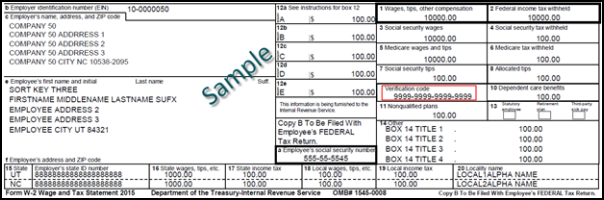
IRS Tests W-2 Verification Code for Filing Season 2017

For filing season 2017, the Internal Revenue Service will expand an initiative to verify the authenticity of Form W-2 data. This initiative is one in a series of steps to combat tax-related identity theft and refund fraud.

The objective is to verify Form W-2 data submitted by taxpayers on e-filed individual tax returns. The IRS has partnered with certain Payroll Service Providers (PSPs) to include a 16-digit code and a new Verification Code field on a limited number of Form W-2 copies provided to employees.
Verification codes will appear on approximately 50 million Forms W-2 in 2017, up from the 2 million forms in 2016. Tax professionals are urged to look for “Verification Code” on W-2s because location will vary.

The code will be displayed in four groups of four alphanumeric characters, separated by hyphens. Example: XXXX-XXXX-XXXX-XXXX.

The Verification Code will appear on some versions of payroll firms’ Form W-2 copies B and C, in a separate, labeled box (Copy B is "To be filed with employee's federal tax return" and Copy C is "For employee's records.")

The form will include these instructions to taxpayer and tax preparers:

Verification Code. If this field is populated, enter this code when it is requested by your tax return preparation software. It is possible your software or preparer will not request the code. The code is not entered on paper-filed returns.

Some Forms W-2 employees receive will have a “Verification Code” box which is blank. These taxpayers do not need to enter any code data into their tax software product.
For the purposes of the test, omitted and incorrect W-2 Verification Codes will not delay the processing of a tax return.

The code will not be included in Forms W-2 or W-2 data submitted by the PSPs to the Social Security Administration or any state or local departments of revenue. Nor will this pilot affect state and local income tax returns or paper federal returns.
Saturday, February 6, 2016

Hiding Money or Income Offshore Resides on the “Dirty Dozen” List of Tax Scams for the 2016 Filing Season

WASHINGTON — The Internal Revenue Service today said avoiding taxes by hiding money or assets in unreported offshore accounts remains on its annual list of tax scams known as the “Dirty Dozen” for the 2015 filing season.

"Our continued enforcement actions should discourage anyone from trying to illegally hide money and income offshore," said IRS Commissioner John Koskinen. "We have voluntary options to help taxpayers get their taxes and filing obligations in order."

Since the first Offshore Voluntary Disclosure Program (OVDP) opened in 2009, there have been more than 54,000 disclosures and we have collected more than $8 billion from this initiative alone.  The IRS conducted thousands of offshore-related civil audits that have produced tens of millions of dollars. The IRS has also pursued criminal charges leading to billions of dollars in criminal fines and restitutions.

The IRS remains committed to our priority efforts to stop offshore tax evasion wherever it occurs.  Even though the IRS has faced several years of budget reductions, the IRS continues to pursue cases in all parts of the world, regardless of whether the person hiding money overseas chooses a bank with no offices on U.S. soil.
Through the years, offshore accounts have been used to lure taxpayers into scams and schemes.

Compiled annually, the “Dirty Dozen” lists a variety of common scams that taxpayers may encounter anytime, but many of these schemes peak during filing season as people prepare their returns or hire people to help with their taxes.

Illegal scams can lead to significant penalties and interest and possible criminal prosecution. IRS Criminal Investigation works closely with the Department of Justice (DOJ) to shut down scams and prosecute the criminals behind them.

Wednesday, February 4, 2015

Falsifying Income to Claim Tax Credits Hits the IRS “Dirty Dozen” List of Tax Scams for the 2015 Filing Season

 WASHINGTON — The Internal Revenue Service today warned taxpayers about schemes to erroneously claim tax credits is on the annual list of tax scams known as the “Dirty Dozen” again for the 2015 filing season.
“Scam artists don't miss a trick and they can entice taxpayers to falsely inflate income on returns to claim tax credits they are not entitled to receive," said IRS Commissioner John Koskinen. "Taxpayers are ultimately responsible for the information on their tax returns, and I urge everyone to file the most accurate return possible."

Compiled annually, the “Dirty Dozen” lists a variety of common scams that taxpayers may encounter anytime but many of these schemes peak during filing season as people prepare their returns or hire professionals to do so.
Illegal scams can lead to significant penalties and interest and possible criminal prosecution. IRS Criminal Investigation works closely with the Department of Justice (DOJ) to shutdown scams and prosecute the criminals behind them.

Don’t Create Fake Income to Qualify for a Credit

Some people falsely increase the income they report to the IRS. This scam involves inflating or including income on a tax return that was never earned, either as wages or as self-employment income, usually in order to maximize refundable credits.

Just like falsely claiming an expense or deduction you did not pay, claiming income you did not earn in order to secure larger refundable credits such as the Earned Income Tax Credit could have serious repercussions. This could result in taxpayers facing a large bill to repay the erroneous refunds, including interest and penalties. In some cases, they can even face criminal prosecution.

Taxpayers may encounter unscrupulous return preparers who make them aware of this scam. Remember: Taxpayers are legally responsible for what’s on their tax return even if it is prepared by someone else. Make sure the preparer you hire is up to the task.

Here are a few tips when choosing a tax preparer:

Wednesday, January 7, 2015

Tax Season Opens As Planned

IR-2014-119, Dec. 29, 2014

WASHINGTON -- Following the passage of the extenders legislation, the Internal Revenue Service announced today it anticipates opening the 2015 filing season as scheduled in January.

The IRS will begin accepting tax returns electronically on Jan. 20. Paper tax returns will begin processing at the same time.

The decision follows Congress renewing a number of "extender" provisions of the tax law that expired at the end of 2013. These provisions were renewed by Congress through the end of 2014. The final legislation was signed into law Dec 19, 2014.

"We have reviewed the late tax law changes and determined there was nothing preventing us from continuing our updating and testing of our systems," said IRS Commissioner John Koskinen. "Our employees will continue an aggressive schedule of testing and preparation of our systems during the next month to complete the final stages needed for the 2015 tax season."

The IRS reminds taxpayers that filing electronically is the most accurate way to file a tax return and the fastest way to get a refund. There is no advantage to people filing tax returns on paper in early January instead of waiting for e-file to begin.

Thursday, December 19, 2013

IRS Offers Tips for Year-End Giving

IR-2013-98, Dec. 16, 2013

WASHINGTON — Individuals and businesses making contributions to charity should keep in mind several important tax law provisions that have taken effect in recent years. Some of these changes include the following:

Special Tax-Free Charitable Distributions for Certain IRA Owners.

This provision, currently scheduled to expire at the end of 2013, offers older owners of individual retirement arrangements (IRAs) a different way to give to charity. An IRA owner, age 70½ or over, can directly transfer tax-free up to $100,000 per year to an eligible charity. This option, first available in 2006, can be used for distributions from IRAs, regardless of whether the owners itemize their deductions. Distributions from employer-sponsored retirement plans, including SIMPLE IRAs and simplified employee pension (SEP) plans, are not eligible.

2014 Tax Season to Open Jan. 31; e-file and Free File Can Speed Refunds

IR-2013-100, Dec. 18, 2013

WASHINGTON — The Internal Revenue Service today announced plans to open the 2014 filing season on Jan. 31 and encouraged taxpayers to use e-file or Free File as the fastest way to receive refunds.