Thursday, January 26, 2017

Working Grandparents May Be Eligible for EITC

IR-2017-09, Jan. 25, 2017 
WASHINGTON — The Internal Revenue Service wants working grandparents raising grandchildren to be aware of the Earned Income Tax Credit (EITC) and correctly claim it if they qualify. 
The EITC is a federal income tax credit for workers who don't earn a high income ($53,505 or less for 2016) and meet certain eligibility requirements. Because it’s a refundable credit, those who qualify and claim the credit could pay less federal tax, pay no tax or even get a tax refund. The EITC could put an extra $2 or up to $6,269 into a taxpayer’s pocket.
Grandparents and other relatives care for millions of children, but are often not aware that they could claim the children under their care for the EITC. A grandparent who is working and has a grandchild who is a qualifying child living with him or her may qualify for the EITC, even if the grandparent is 65 years of age or older. Generally, to be a qualified child for EITC purposes, the grandchild must meet the dependency requirements.
Special rules and restrictions apply if the child’s parents or other family members also qualify for the EITC. Details including numerous helpful examples can be found in Publication 596, available on IRS.gov. There are also special rules, described in the publication, for individuals receiving disability benefits and members of the military.
Working grandparents are encouraged to find out, not guess, if they qualify for this very important credit. To qualify for EITC, the taxpayer must have earned income either from a job or from self-employment and meet basic rules. Also, certain disability payments may qualify as earned income for EITC purposes. EITC eligibility also depends on family size. The IRS recommends using the EITC Assistant, on IRS.gov, to determine eligibility, estimate the amount of credit and more.
Eligible taxpayers must file a tax return, even if they do not owe any tax or are not required to file. Qualified taxpayers should consider claiming the EITC by filing electronically: through a qualified tax professional; using free community tax help sites; or doing it themselves with IRS Free File.
Many EITC filers will get their refunds later this year than in past years. That’s because a new law requires the IRS to hold refunds claiming the EITC and the Additional Child Tax Credit (ACTC) until mid-February. The IRS cautions taxpayers that these refunds likely will not start arriving in bank accounts or on debit cards until the week of Feb. 27. Taxpayers claiming the EITC or ACTC should file as soon as they have all of the necessary documentation together to prepare an accurate return. In other words, file as they normally would.

The IRS and partners nationwide will hold the annual EITC Awareness Day on Friday, Jan. 27, 2017 to alert millions of workers who may be missing out on this significant tax credit and other refundable credits. One easy way to support this outreach effort is by participating on the IRS Thunderclap to help promote #EITCAwarenessDay through social media. For more information on EITC and other refundable credits, visit the EITC page on IRS.gov.

Thursday, January 19, 2017

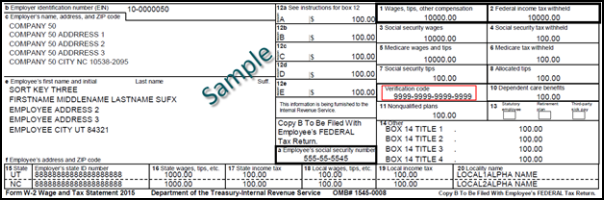
IRS Tests W-2 Verification Code for Filing Season 2017

For filing season 2017, the Internal Revenue Service will expand an initiative to verify the authenticity of Form W-2 data. This initiative is one in a series of steps to combat tax-related identity theft and refund fraud.

The objective is to verify Form W-2 data submitted by taxpayers on e-filed individual tax returns. The IRS has partnered with certain Payroll Service Providers (PSPs) to include a 16-digit code and a new Verification Code field on a limited number of Form W-2 copies provided to employees.
Verification codes will appear on approximately 50 million Forms W-2 in 2017, up from the 2 million forms in 2016. Tax professionals are urged to look for “Verification Code” on W-2s because location will vary.

The code will be displayed in four groups of four alphanumeric characters, separated by hyphens. Example: XXXX-XXXX-XXXX-XXXX.

The Verification Code will appear on some versions of payroll firms’ Form W-2 copies B and C, in a separate, labeled box (Copy B is "To be filed with employee's federal tax return" and Copy C is "For employee's records.")

The form will include these instructions to taxpayer and tax preparers:

Verification Code. If this field is populated, enter this code when it is requested by your tax return preparation software. It is possible your software or preparer will not request the code. The code is not entered on paper-filed returns.

Some Forms W-2 employees receive will have a “Verification Code” box which is blank. These taxpayers do not need to enter any code data into their tax software product.
For the purposes of the test, omitted and incorrect W-2 Verification Codes will not delay the processing of a tax return.

The code will not be included in Forms W-2 or W-2 data submitted by the PSPs to the Social Security Administration or any state or local departments of revenue. Nor will this pilot affect state and local income tax returns or paper federal returns.

Thursday, April 7, 2016

IRS Offers New Cash Payment Option

WASHINGTON — The Internal Revenue Service announced today a new payment option for individual taxpayers who need to pay their taxes with cash. In partnership with ACI Worldwide’s OfficialPayments.com and the PayNearMe Company, individuals can now make a payment without the need of a bank account or credit card at over 7,000 7-Eleven stores nationwide.

“We continue to look for new ways to provide services for our taxpayers. Taxpayers have many options to pay their tax bills by direct debit, a check or a credit card, but this provides a new way for people who can only pay their taxes in cash without having to travel to an IRS  Taxpayer Assistance Center," said IRS Commissioner John Koskinen.

Individuals wishing to take advantage of this payment option should visit the IRS.gov payments page, select the cash option in the other ways you can pay section and follow the instructions:

Thursday, March 24, 2016

SIX Facts You Should Know Before Deducting a Charitable Donation

If you gave money or goods to a charity in 2015, you may be able to claim a deduction on your federal tax return. Here are six important facts you should know about charitable donations.

1. Qualified Charities. You must donate to a qualified charity. Gifts to individuals, political organizations or candidates are not deductible. An exception to this rule is contributions under the Slain Officer Family Support Act of 2015. To check the status of a charity, use the IRS Select Check tool.

2. Itemize Deductions. To deduct your contributions, you must file Form 1040 and itemize deductions. File Schedule A, Itemized Deductions, with your federal tax return.

Friday, March 18, 2016

IRS Removes Some Restrictions on Cuba Income

Tuesday, March 1, 2016

Home Energy Credits Save Money and Cut Taxes

You can trim your taxes and save on your energy bills with certain home improvements. Here are some key facts to know about home energy tax credits:

Non-Business Energy Property Credit 
  • Part of this credit is worth 10 percent of the cost of certain qualified energy-saving items you added to your main home last year. This may include items such as insulation, windows, doors and roofs.
  • The other part of the credit is not a percentage of the cost. It is for the actual cost of certain property. This may include items like water heaters and heating and air conditioning systems. The credit amount for each type of property has a different dollar limit.

Friday, February 26, 2016

5 Things You Should Know about the Child Tax Credit

The Child Tax Credit is an important tax credit that may save you up to $1,000 for each eligible qualifying child. Be sure you qualify before you claim it. Here are five useful facts from the IRS on the Child Tax Credit: 

Wednesday, February 17, 2016

Deciding Whether to Itemize or Use the Standard Deduction - 5 steps

Most people claim the standard deduction when they file their federal tax return, but you may be able to lower your tax bill if you itemize. You can find out which way saves you the most by figuring your taxes both ways. The IRS offers these six tips to help you choose:

1. Figure Your Itemized Deductions. Add up deductible expenses you paid during the year. These may include expenses such as:
  • Home mortgage interest
  • State and local income taxes or sales taxes (but not both)
  • Real estate and personal property taxes
  • Gifts to charities
  • Casualty or theft losses
  • Unreimbursed medical expenses
  • Unreimbursed employee business expenses
Special rules and limits apply. Visit IRS.gov and refer to Publication 17, Your Federal Income Tax, for more details.

Tuesday, February 9, 2016

Obtaining and Claiming a Health Coverage Exemption

The Affordable Care Act requires you and each member of your family to have minimum essential coverage, qualify for an insurance coverage exemption, or make an individual shared responsibility payment for months without coverage or an exemption when you file your federal income tax return.

You, your spouse or your dependents may be eligible to claim an exemption from the requirement to have coverage and are not required to make a payment. .For any month that you do not qualify for a coverage exemption, you will need to have minimum essential coverage or make a shared responsibility payment.

You can claim most exemptions when you file your tax return. However, you must apply for certain exemptions in advance through the Health Insurance Marketplace, You may be exempt if:
  • The minimum amount you must pay for the annual premiums is more than 8.05 percent of your household income
  • You have a gap in coverage that is less than three consecutive months
  • You qualify for an exemption for one of several other reasons, including having a hardship that prevents you from obtaining coverage, or belonging to a group explicitly exempt from the requirement

Saturday, February 6, 2016

Hiding Money or Income Offshore Resides on the “Dirty Dozen” List of Tax Scams for the 2016 Filing Season

WASHINGTON — The Internal Revenue Service today said avoiding taxes by hiding money or assets in unreported offshore accounts remains on its annual list of tax scams known as the “Dirty Dozen” for the 2015 filing season.

"Our continued enforcement actions should discourage anyone from trying to illegally hide money and income offshore," said IRS Commissioner John Koskinen. "We have voluntary options to help taxpayers get their taxes and filing obligations in order."

Since the first Offshore Voluntary Disclosure Program (OVDP) opened in 2009, there have been more than 54,000 disclosures and we have collected more than $8 billion from this initiative alone.  The IRS conducted thousands of offshore-related civil audits that have produced tens of millions of dollars. The IRS has also pursued criminal charges leading to billions of dollars in criminal fines and restitutions.

The IRS remains committed to our priority efforts to stop offshore tax evasion wherever it occurs.  Even though the IRS has faced several years of budget reductions, the IRS continues to pursue cases in all parts of the world, regardless of whether the person hiding money overseas chooses a bank with no offices on U.S. soil.
Through the years, offshore accounts have been used to lure taxpayers into scams and schemes.

Compiled annually, the “Dirty Dozen” lists a variety of common scams that taxpayers may encounter anytime, but many of these schemes peak during filing season as people prepare their returns or hire people to help with their taxes.

Illegal scams can lead to significant penalties and interest and possible criminal prosecution. IRS Criminal Investigation works closely with the Department of Justice (DOJ) to shut down scams and prosecute the criminals behind them.

Thursday, January 14, 2016

Get to Know Your Taxpayer Bill of Rights

Every taxpayer has a set of fundamental rights. The “Taxpayer Bill of Rights” takes the many existing rights in the tax code and groups them into 10 categories. You should be aware of these rights when you interact with the IRS.

Publication 1, Your Rights as a Taxpayer, highlights a list of your rights and the agency’s obligations to protect them. Here is a summary of the Taxpayer Bill of Rights:

  1. The Right to Be Informed. Taxpayers have the right to know what is required to comply with the tax laws. They are entitled to clear explanations of the laws and IRS procedures in all tax forms, instructions, publications, notices and correspondence. They have the right to know about IRS decisions affecting their accounts and clear explanations of the outcomes.
  2. The Right to Quality Service. Taxpayers have the right to receive prompt, courteous and professional assistance in their dealings with the IRS and the freedom to speak to a supervisor about inadequate service. Communications from the IRS should be clear and easy to understand.
  3. The Right to Pay No More than the Correct Amount of Tax. Taxpayers have the right to pay only the amount of tax legally due, including interest and penalties. They should also expect the IRS to apply all tax payments properly.
  4. The Right to Challenge the IRS’s Position and Be Heard. Taxpayers have the right to object to formal IRS actions or proposed actions and provide justification with additional documentation. They should expect that the IRS will consider their timely objections and documentation promptly and fairly. If the IRS does not agree with their position, they should expect a response.
  5. The Right to Appeal an IRS Decision in an Independent Forum. Taxpayers are entitled to a fair and impartial administrative appeal of most IRS decisions, including certain penalties. Taxpayers have the right to receive a written response regarding a decision from the Office of Appeals. Taxpayers generally have the right to take their cases to court.
  6. The Right to Finality. Taxpayers have the right to know the maximum amount of time they have to challenge an IRS position and the maximum amount of time the IRS has to audit a particular tax year or collect a tax debt. Taxpayers have the right to know when the IRS concludes an audit.
  7. The Right to Privacy. Taxpayers have the right to expect that any IRS inquiry, examination or enforcement action will comply with the law and be as unobtrusive as possible. They should expect such proceedings to respect all due process rights, including search and seizure protections. The IRS will provide, where applicable, a collection due process hearing.
  8. The Right to Confidentiality. Taxpayers have the right to expect that their tax information will remain confidential. The IRS will not disclose information unless authorized by the taxpayer or by law. Taxpayers should expect the IRS to take appropriate action against employees, return preparers and others who wrongfully use or disclose their return information.
  9. The Right to Retain Representation. Taxpayers have the right to retain an authorized representative of their choice to represent them in their dealings with the IRS. Taxpayers have the right to seek assistance from a Low Income Taxpayer Clinic if they cannot afford representation.
  10. The Right to a Fair and Just Tax System. Taxpayers have the right to expect fairness from the tax system. This includes considering all facts and circumstances that might affect their underlying liabilities, ability to pay or ability to provide information timely. Taxpayers have the right to receive assistance from the Taxpayer Advocate Service if they are experiencing financial difficulty or if the IRS has not resolved their tax issues properly and timely through its normal channels.

In an effort to expand awareness, the IRS has made Publication 1 available in  English, Chinese, Korean, Russian, Spanish andVietnamese.

The IRS will include Publication 1 when sending a notice to taxpayers on a range of issues, such as an audit or collection matter. All IRS facilities will publicly display the rights for taxpayers and employees to see.

Additional IRS Resources:

IRS YouTube Videos:

IRS Podcasts:

Monday, January 4, 2016

Internal Revenue Service Reminds Taxpayers to Plan Ahead If You Need a Tax Transcript

IR-2015-140, Dec. 23, 2015                                                                                    Español
WASHINGTON — The IRS reminds taxpayers that the quickest way to get a copy of their tax transcript is to order it online using the Get Transcript application on IRS.gov. By planning ahead, they should receive their transcript in the mail within five to 10 days from the time the IRS receives the request online.
The IRS continues to work to bring the viewable/printable functionality of the application back online in the near future with enhanced identity protection security features. In the meantime, taxpayers can still request a mailed transcript by going online to Get Transcript.
Though taxpayers should always keep a copy of their tax return for their records, some may need the information from filed tax returns for many reasons. This includes college financial aid applicants or taxpayers who have applied for a loan to buy a home or start a business.
If a taxpayer is returning to college this January and applying for financial aid, they should check with their financial aid department at school to see if they will need a copy of their transcript before they start classes. Frequently, students get all the tax return information they need on the FAFSA application via the IRS Data Retrieval Tool.  
Similarly, if a taxpayer plans to apply for a loan, they should ask their financial institution if a transcript will be necessary so they can plan ahead and have it at the appropriate time.
The fastest way to get a transcript is through the Get Transcript tool on IRS.gov. Although the IRS temporarily stopped the online viewing and printing of transcripts, Get Transcript still allows taxpayers to order their transcript online and receive it by mail.  Taxpayers simply click the "Get a Transcript by Mail" button to order the paper copy of their transcript and have it sent to their address of record.  Among the options available:
  • To order a transcript online and have it delivered by mail, go to IRS.gov and use the Get Transcript tool. 
  • To order by phone, call 800-908-9946 and follow the prompts.
  • To request an individual tax return transcript by mail or fax, complete Form 4506T-EZ, Short Form Request for Individual Tax Return Transcript. Businesses and individuals who need a tax account transcript should use Form 4506-T, Request for Transcript of Tax Return.
The IRS will mail the transcript to the address of record entered on the prior year’s tax return. The mailed transcript is an official document. It does not need to be a “certified” copy as is the case with some other documents. If a taxpayer has moved since they last filed a tax return with the IRS, they need to first submit Form 8822, Change of Address, to ensure that the transcript is mailed to the correct address. Allowing time for the Form 8822 is another reason for taxpayers to plan ahead for their transcript needs.  
If a taxpayer is applying for financial aid, they are encouraged to use the IRS Data Retrieval Tool on the FAFSA website to easily import their tax return information to their financial aid application. The temporary shutdown of the Get Transcript tool does not affect the Data Retrieval Tool. Taxpayers may also click on the FAFSA help page for more information.
If they are applying for a mortgage, most mortgage companies only require a tax return transcript for income verification purposes. Most of these companies participate in our IVES (Income Verification Express Service) program and can request (with the taxpayer’s consent) to have a transcript sent directly to the financial institution. If a taxpayer needs to order a transcript, they should follow the process described above and have it mailed to the address the IRS has on file for them.
Remember, ordering a transcript online is the quickest option. For more information, read the IRSHow Do I Get My Transcript? fact sheet.

Wednesday, December 30, 2015

2016 Standard Mileage Rates for Business, Medical and Moving Announced


IR-2015-137, Dec.17, 2015
WASHINGTON — The Internal Revenue Service today issued the 2016 optional standard mileage rates used to calculate the deductible costs of operating an automobile for business, charitable, medical or moving purposes.
Beginning on Jan. 1, 2016, the standard mileage rates for the use of a car (also vans, pickups or panel trucks) will be:

Thursday, December 10, 2015

For Same-Sex Couples and Certain Domestic Partners

The theft of your identity, especially personal information such as your name, Social Security number, address and children’s names, can be traumatic and frustrating. In this online era, it’s important to always be on guard.
The IRS has teamed up with state revenue departments and the tax industry to make sure you understand the dangers to your personal and financial data. Taxes. Security. Together. Working in partnership with you, we can make a difference.
Here are seven steps you can make part of your routine to protect your tax and financial information:
  1. Read your credit card and banking statements carefully and often – watch for even the smallest charge that appears suspicious. (Neither your credit card nor bank – or the IRS – will send you emails asking for sensitive personal and financial information such as asking you to update your account.)
  2. Review and respond to all notices and correspondence from the Internal Revenue Service. Warning signs of tax-related identity theft can include IRS notices about tax returns you did not file, income you did not receive or employers you’ve never heard of or where you’ve never worked.
  3. Review each of your three credit reports at least once a year. Visit annualcreditreport.com to get your free reports.
  4. Review your annual Social Security income statement for excessive income reported. You can sign up for an electronic account at www.SSA.gov.
  5. Read your health insurance statements; look for claims you never filed or care you never received.
  6. Shred any documents with personal and financial information. Never toss documents with your personally identifiable information, especially your social security number, in the trash.
  7. If you receive any routine federal deposit such as Social Security Administrator or Department of Veterans Affairs benefits, you probably receive those deposits electronically. You can use the same direct deposit process for your federal and state tax refund. IRS direct deposit is safe and secure and places your tax refund directly into the financial account of your choice.
To learn additional steps you can take to protect your personal and financial data, visit Taxes. Security. Together. You also can read Publication 4524, Security Awareness for Taxpayers.
Each and every taxpayer has a set of fundamental rights they should be aware of when dealing with the IRS. These are your Taxpayer Bill of Rights. Explore your rights and our obligations to protect them on IRS.gov.
Additional IRS Resources:
IRS YouTube Videos:
IRS Podcasts:

Tuesday, November 24, 2015

IRS Tax Tips for Deducting Gifts to Charity


IRS.gov Banner
IRS Tax TipsNovember 24, 2015


Useful Links:

IRS.gov
Help For Hurricane Victims

News Essentials

What's Hot
News Releases
IRS - The Basics
IRS Guidance
Media Contacts
Facts & Figures
Around The Nation
e-News Subscriptions

The Newsroom Topics

Multimedia Center
Noticias en Español
Radio PSAs
Tax Scams/Consumer Alerts
The Tax Gap
Fact Sheets
IRS Tax Tips
Armed Forces
Latest News

IRS Resources

Compliance & Enforcement News
Contact Your Local IRS Office
Filing Your Taxes
Forms & Pubs
Frequently Asked Questions
Taxpayer Advocate Service
Where to File
IRS Social Media


Issue Number:    IRS Special Edition Tax Tip 2015-20

Inside This Issue


IRS Tax Tips for Deducting Gifts to Charity
The holiday season often prompts people to give money or property to charity. If you plan to give and want to claim a tax deduction, there are a few tips you should know before you give. For instance, you must itemize your deductions. Here are six more tips that you should keep in mind:
1. Give to qualified charities. You can only deduct gifts you give to a qualified charity. Use the IRS Select Check tool to see if the group you give to is qualified. You can deduct gifts to churches, synagogues, temples, mosques and government agencies. This is true even if Select Check does not list them in its database.
2. Keep a record of all cash gifts.  Gifts of money include those made in cash or by check, electronic funds transfer, credit card and payroll deduction. You must have a bank record or a written statement from the charity to deduct any gift of money on your tax return. This is true regardless of the amount of the gift. The statement must show the name of the charity and the date and amount of the contribution. Bank records include canceled checks, or bank, credit union and credit card statements. If you give by payroll deductions, you should retain a pay stub, a Form W-2 wage statement or other document from your employer. It must show the total amount withheld for charity, along with the pledge card showing the name of the charity.
3. Household goods must be in good condition.  Household items include furniture, furnishings, electronics, appliances and linens. These items must be in at least good-used condition to claim on your taxes. A deduction claimed of over $500 does not have to meet this standard if you include a qualified appraisal of the item with your tax return.
4. Additional records required.  You must get an acknowledgment from a charity for each deductible donation (either money or property) of $250 or more. Additional rules apply to the statement for gifts of that amount. This statement is in addition to the records required for deducting cash gifts. However, one statement with all of the required information may meet both requirements.
5. Year-end gifts.  Deduct contributions in the year you make them. If you charge your gift to a credit card before the end of the year it will count for 2015. This is true even if you don’t pay the credit card bill until 2016. Also, a check will count for 2015 as long as you mail it in 2015.
6. Special rules.  Special rules apply if you give a car, boat or airplane to charity. If you claim a deduction of more than $500 for a noncash contribution, you will need to file another form with your tax return. UseForm 8283, Noncash Charitable Contributions to report these gifts. For more on these rules, visit IRS.gov.
Each and every taxpayer has a set of fundamental rights they should be aware of when dealing with the IRS. These are your Taxpayer Bill of Rights. Explore your rights and our obligations to protect them on IRS.gov.
Additional IRS Resources:
IRS YouTube Videos:
IRS Podcasts:

Thank you for subscribing to IRS Tax Tips, an IRS e-mail service. For more information on federal taxes please visit IRS.gov.
This message was distributed automatically from the IRS Tax Tips mailing list. Please Do Not Reply To This Message.